October 7, 2026
How to Build Affiliate Websites That Actually Generate Passive Income
By @443mqrhrdm
Affiliate marketing has been around for decades, but the way people approach it has changed dramatically. What used to require manual product reviews, endless outreach for backlinks, and weeks of waiting for Google to notice your content can now be accelerated with the right strategy. If you want to build affiliate websites that produce consistent passive income, you need to combine timeless SEO fundamentals with modern tools that help you work smarter, not harder.
The mistake most beginners make is treating an affiliate site like a side hustle that requires constant attention. They write a few posts, set up some Amazon Associates links, and then wonder why traffic never arrives. The truth is that building a sustainable affiliate business means constructing a system that runs on autopilot, even while you sleep. This is where artificial intelligence and content automation come into play, but only if you first understand the foundation.
Start With the Right Niche and Platform
Before you even think about keywords or backlinks, pick an evergreen niche. An evergreen niche is one that maintains steady demand regardless of season or trends. Think home improvement, personal finance, pet care, health and wellness, or parenting. These categories have audiences that will always search for solutions, and affiliate programs like Amazon Associates and ClickBank offer products and services with solid commissions.
Once you have your niche, choose a hosting provider that balances speed and cost. Hostinger is a popular choice for beginners because it offers managed WordPress hosting at a low price. Setting up your site on WordPress gives you full control over design, plugins, and SEO settings. After the site is live, route traffic through Cloudflare to protect against attacks and speed up content delivery. A fast site is non-negotiable for both user experience and search engine rankings.
SEO Is Still the Engine That Drives Traffic
Without SEO, your affiliate site is just a collection of links no one will see. The core of SEO has not changed: you need to identify search terms your target audience uses, create content that answers their questions, and earn links from other websites that vouch for your authority. Tools like Ahrefs and Semrush help you find keywords with decent search volume and manageable competition. They also show you what your competitors are ranking for, so you can spot gaps in their content and fill them.

Google Search Console is essential for monitoring how your site performs in search results. It tells you which queries bring visitors, what your average position is, and whether Google sees any technical issues with your pages. Pair that with Google Analytics to understand what visitors do once they land on your site. If they bounce quickly, your content or page speed needs work.
Domain authority is a metric that reflects how likely your site is to rank. It grows slowly as you earn backlinks from reputable sources. Link building is the hardest part of affiliate SEO, but it is also the most rewarding. You can start by guest posting on relevant blogs, creating resource pages that other sites want to cite, or reaching out to product manufacturers for partnerships. Over time, each strong link pushes your site higher in search results.
Let Artificial Intelligence Handle the Heavy Lifting
This is where modern affiliate sites gain a real advantage. Tools that leverage artificial intelligence and natural language processing can help you produce content at scale without sacrificing quality. ChatGPT and Jasper AI, for example, can generate product descriptions, comparison tables, and even full articles based on your outline. But the key is to use them as a starting point, not a final product. You still need to fact-check, add personal experience, and tweak the tone to match your voice.
Content automation is not about replacing the writer. It is about removing the friction that stops people from building sites in the first place. When you can draft a 1,500-word review in ten minutes instead of three hours, you free up time for outreach, analysis, and strategy. That efficiency is what allows you to build affiliate websites across multiple niches without burning out.
One concrete example: suppose you are reviewing vacuum cleaners. You can ask an AI tool to generate a list of the top ten models with their key features. Then you add your own observations about noise level, ease of emptying the bin, or how well each model handles pet hair. That blend of AI speed and human insight creates content that ranks well and converts readers into buyers.
Monetization That Doesn't Feel Pushy
The most profitable affiliate sites do not scream "buy now." They guide the reader to a solution. An article that helps someone choose between two products, with honest pros and cons, will earn more commissions over the long term than a page that simply lists links. Amazon Associates works well for physical products, while ClickBank is stronger for digital goods like courses and software. Diversify your income streams so that a change in one program's policies does not kill your revenue.
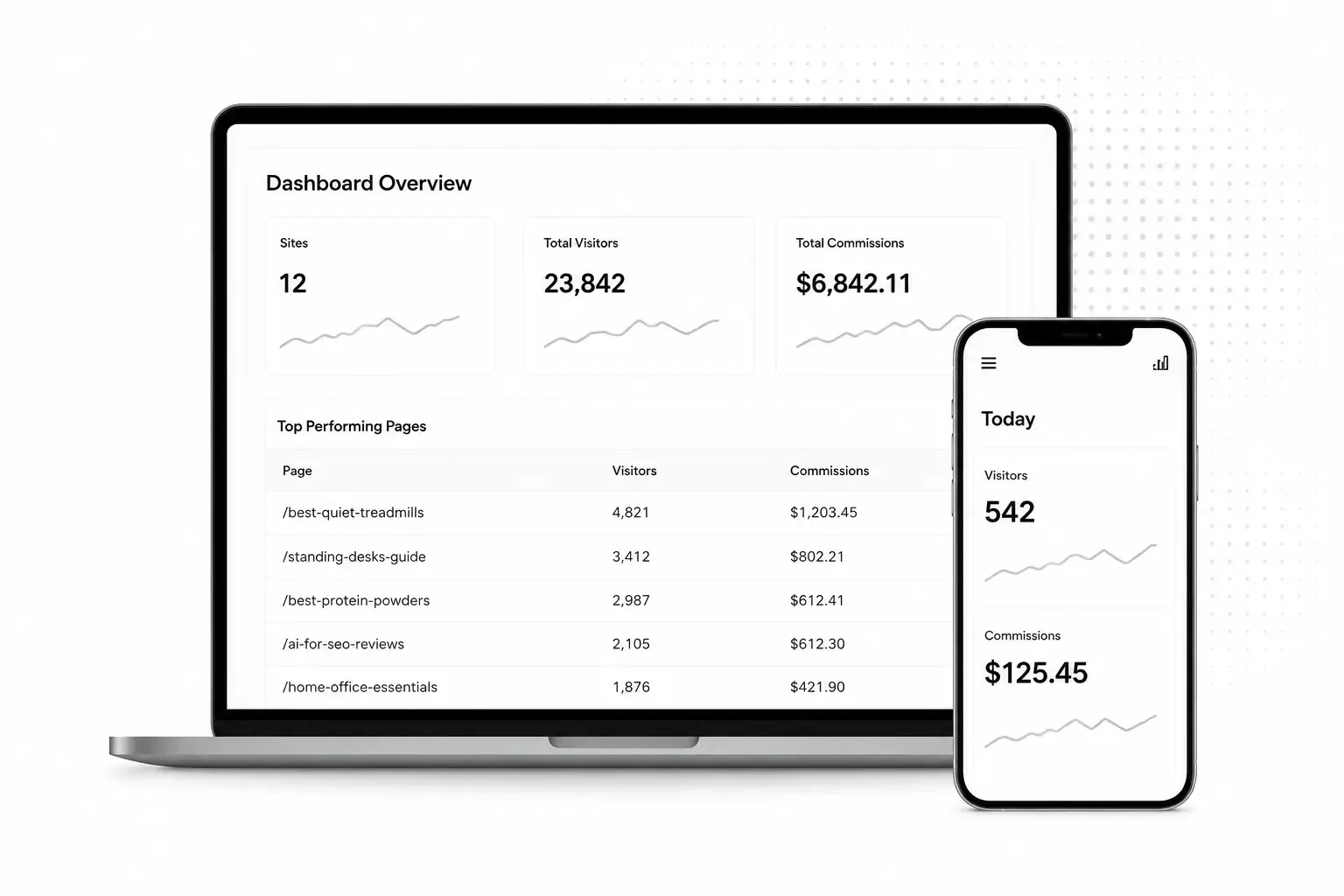
Passive income from affiliate sites is real, but it is not instant. Most sites take six to twelve months to gain traction. The sites that succeed are the ones where the owner kept publishing, kept optimizing old content, and kept building links even when traffic was flat. Patience and consistency matter more than any single tactic.
A Practical Workflow for Getting Started
- Choose an evergreen niche with products you can honestly recommend.
- Set up WordPress on Hostinger, install a lightweight theme, and connect Cloudflare.
- Use Ahrefs or Semrush to find 20 to 30 keywords with medium competition.
- Write or generate content using ChatGPT or Jasper AI, then edit it for accuracy and voice.
- Submit your site to Google Search Console and start promoting each post to earn backlinks.
This workflow is repeatable. Once you have it down, you can build affiliate websites in different niches using the same blueprint. Each site becomes another stream of passive income, and over time the total grows without a proportional increase in effort.
Common Pitfalls and How to Avoid Them
The biggest trap is choosing a niche you do not care about. If you force yourself to write about topics that bore you, the content will sound flat and readers will sense it. Pick something you already know or are willing to learn deeply. The second trap is ignoring technical SEO. A slow site, broken links, or missing meta descriptions will kill your rankings regardless of how good your content is. Use Google Search Console and Google Analytics to catch these issues early.
Another mistake is relying solely on AI content without editing. Search engines are getting better at detecting low-effort AI text, and users can tell when a page feels generic. Always add your own perspective, examples, or data. That is what separates a site that ranks from a site that gets penalized.

Final Thoughts on Building for the Long Run
If you want to build affiliate websites that produce real passive income, treat the process like building a business, not a hobby. Invest in the right tools, learn the fundamentals of SEO, and use artificial intelligence to amplify your efforts, not replace your judgment. The sites that last are the ones that offer genuine value to their readers. Commissions are a byproduct of trust, not the other way around.
Start small, stay consistent, and keep learning. The affiliate marketing landscape shifts, but the principles of providing useful information and earning links have not changed. With the combination of evergreen niches, solid SEO, and modern content automation, you can create a portfolio of sites that generate income month after month with minimal ongoing work.
❧